Sales Strategy & Deal Management
Why Deals Get Stuck in "Pipeline Limbo" (And How Mutual Action Plans Fix It)
Stalled deals are rarely caused by a lack of interest; they happen because buyers don't know what step to take next. This article breaks down how to use lightweight Mutual Action Plans (MAPs) to align buyer-seller milestones, prevent procurement bottlenecks, and shorten your sales cycle.
3 min read

Tanner Randall
Founder, Kollab
We’ve all experienced it: A discovery call goes fantastically well, the prospect agrees your product is a great fit, and they promise to “get back to you next week.”
Then… silence.
When deals stall after a successful meeting, sales reps often assume the buyer lost interest. But in reality, the buyer is just lost. B2B purchasing is complex, crowded with internal stakeholders, and rarely something your prospect does every day. Without a clear path forward, momentum evaporates.
The fix isn’t more follow-up emails—it’s a Mutual Action Plan (MAP).
What is a Mutual Action Plan?
A Mutual Action Plan is a shared roadmap between a buyer and a seller that outlines every step required to go from initial interest to a signed contract and successful launch.
Instead of treating the sales process as something you do to a prospect, a MAP turns it into a project you complete with them.
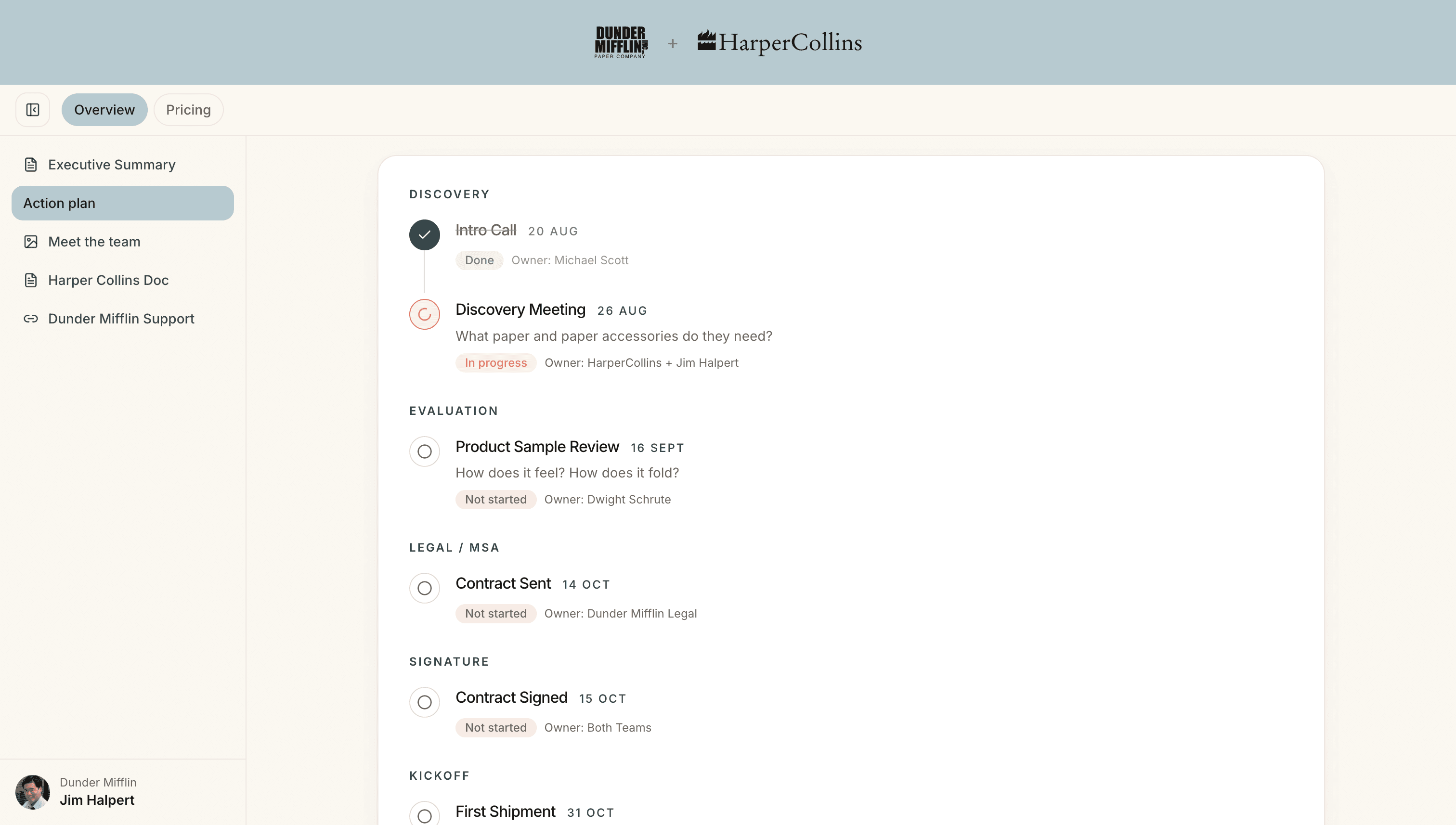
The 3 Big Mistakes Reps Make with MAPs
When reps try to implement action plans, they often make three critical mistakes that scare buyers away:
1. Over-Complicating with Spreadsheets
Sending a buyer a massive Excel spreadsheet with 40 rows of tasks, Gantt charts, and complex formulas creates instant anxiety. A MAP should feel like a relief, not a new project management chore.
2. Making It One-Sided
If every task on the list is assigned to the buyer (“Review security,” “Get budget approval,” “Sign contract”), they’ll feel managed. A true plan balances accountability: your team takes on tasks alongside theirs.
3. Hiding the Roadmap in an Attachment
If your plan lives in an emailed PDF or a buried Google Doc, it gets lost immediately. To be effective, the roadmap needs to live right alongside your sales collateral in a single, accessible workspace.
How to Build a Frictionless MAP
Keep your action plan simple, visible, and focused on key milestones:
Focus on 3-5 Major Phases: Keep it high-level (e.g., Technical Alignment, Legal Review, Procurement, Onboarding).
Assign Clear Owners & Dates: Explicitly name who owns each task—on both the buyer and seller side.
Make Progress Visual: Use visual checkmarks and status indicators so decision-makers can see the deal moving forward in real time.
Take the Guesswork Out of Buying
When you give your prospect a clear, interactive roadmap, you position yourself as an expert advisor rather than just another vendor pushing a product.
Simplify the buying process, keep both sides accountable, and watch your deal velocity jump.
Every tactic here gets easier when the deal has one home. Kollab puts the plan, the stakeholders, and the next step in a single link. See pricing — free to start.